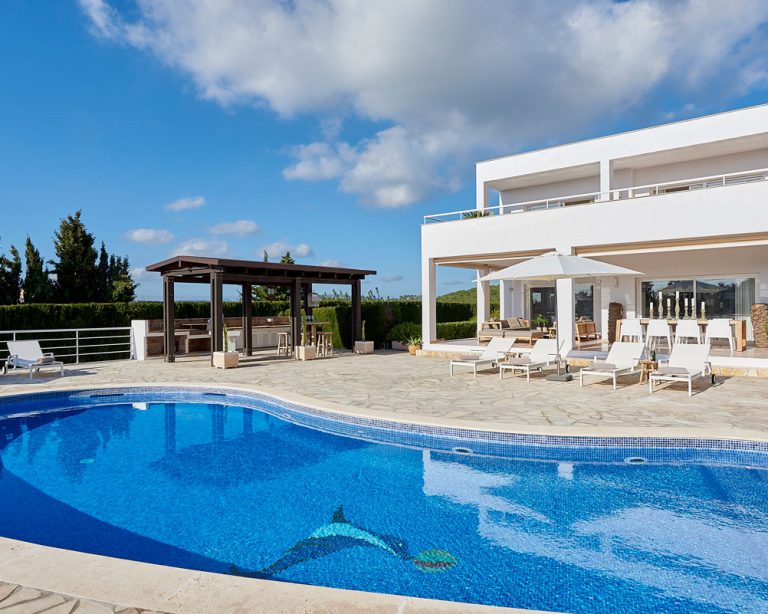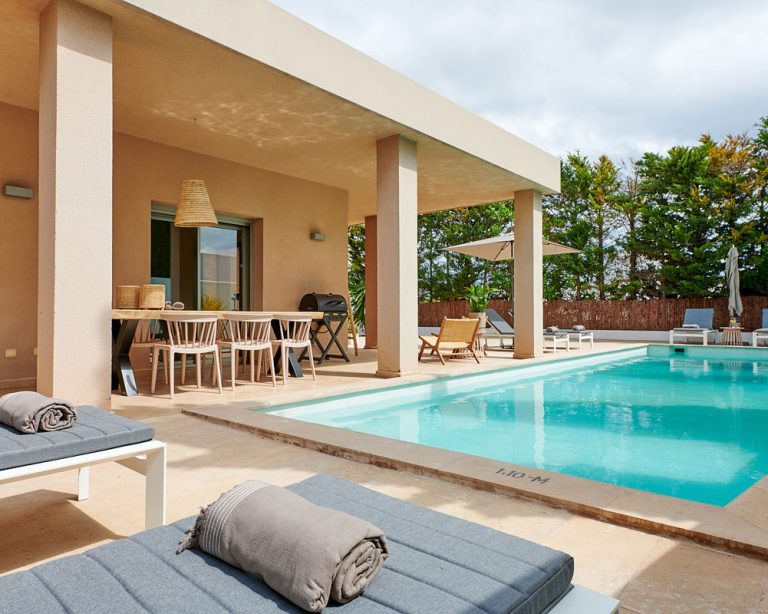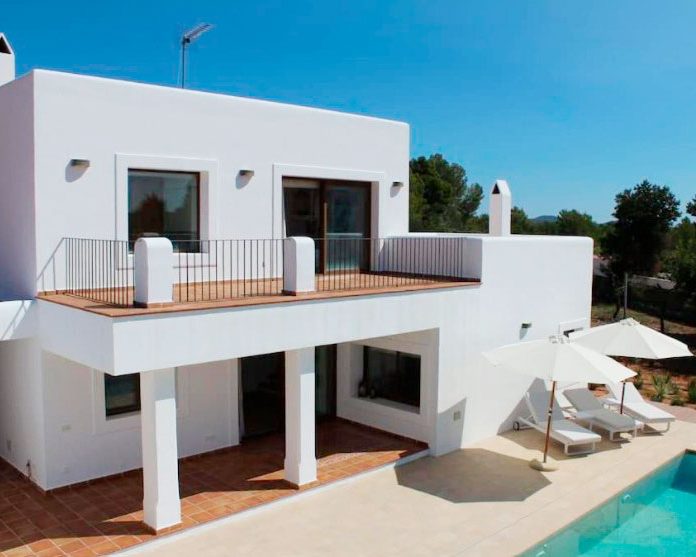
THE IBIZEAN HOUSE
FROM BLAKSTAD TO LUBICZ
Blakstad, an architect and resident of Ibiza since 1956, and Lubicz, a physicist who studied ancient geometry, were contemporaries but never met.
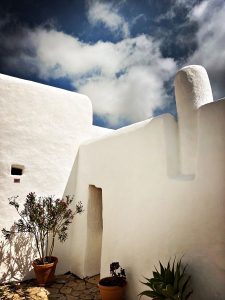
However, the two come together, each from their own perspective, to provide us with insights into the ancient heritage of Ibizan houses and the character hidden in their constituent elements and distinctive structure.
Photografy by @dosmares_ibiza
Text by Daniel Foraster
Time is often the one that shows us the meaning of what happens, both to us and to the world around us. Although sometimes it does so to point out precisely what eludes it, what it hasn’t yet managed to capture.
It’s been years since we left Barcelona for Formentera, and not so long since we arrived in Ibiza. We could list a long list of reasons why we move from one place to another, but there’s one that sooner or later always reveals itself to us amidst the tangle of everyday life: the search for the sensitive, the wild, for the harmony between man and nature, for the essence, in short, for that which still remains elusive to time.
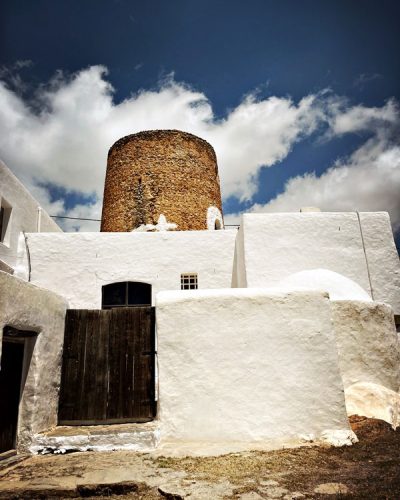
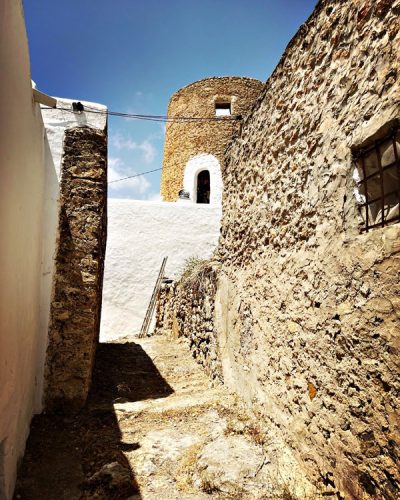
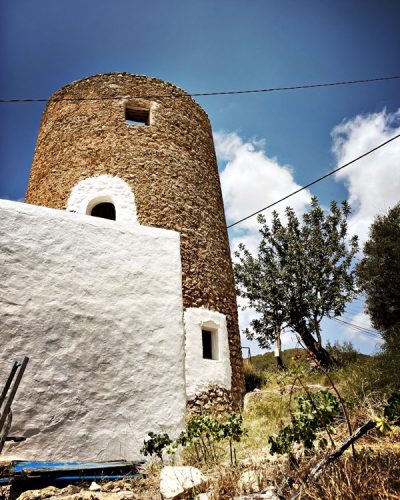
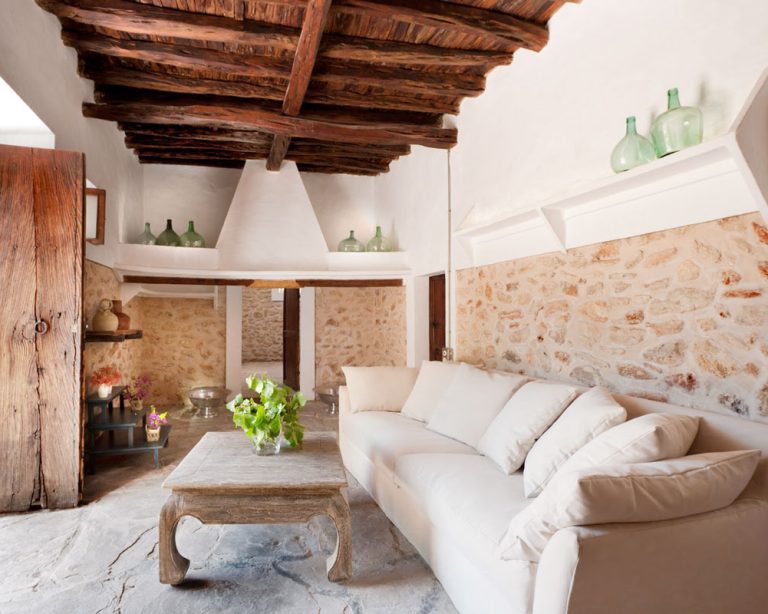
And here, in Ibiza, it couldn’t be any other way. On this island, seemingly iconic for its image and immediate fun, for the night that can’t wait, we came across one day, almost by chance, on the driveway of a house we were going to visit, the serene gaze of a century-old olive tree. And then, inside the house, with the original floor made of irregular slabs, with hand-cut juniper wood beams, and an old wood-burning oven carved into the wide stone walls of the kitchen.
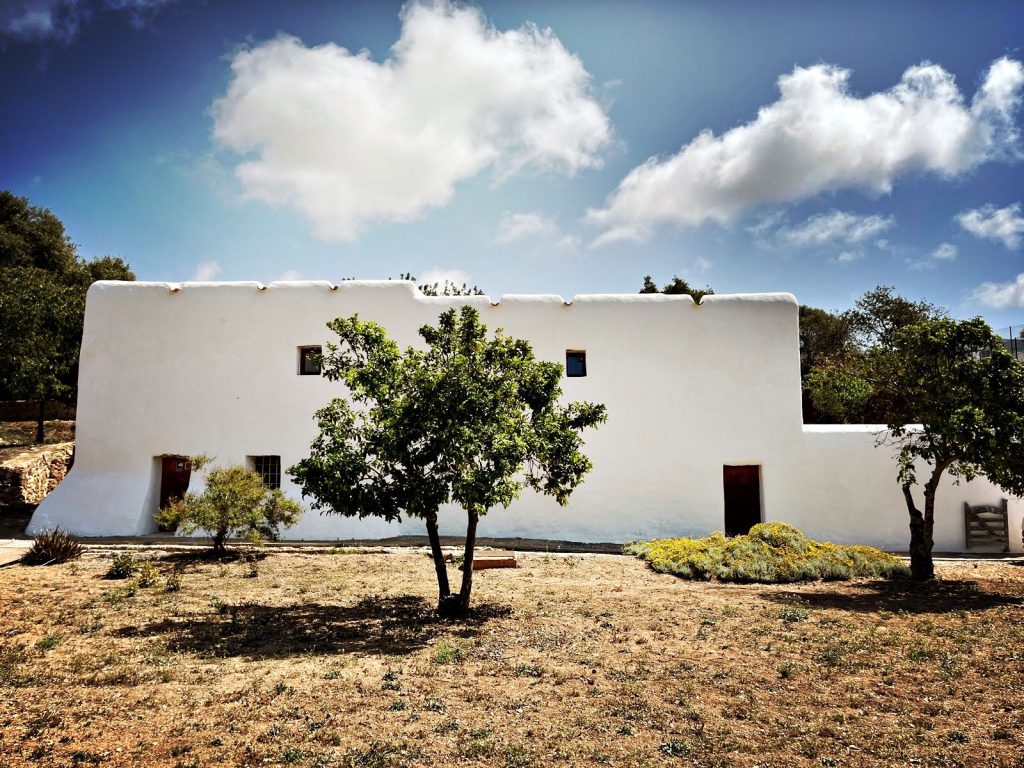
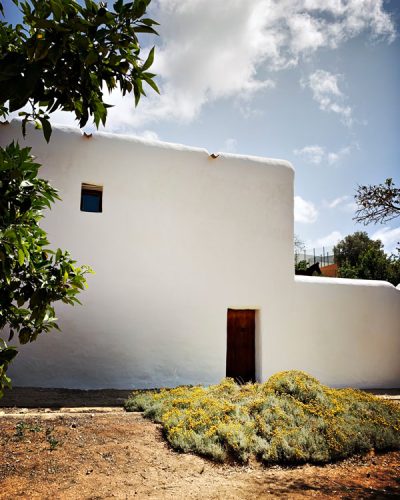
The house had been renovated, after being abandoned for decades, by the descendants of the former family that owned the estate. But they wanted to preserve details belonging to a past that spoke of several generations, succeeding one another beneath those beams, on that floor.
The emotion we felt that morning awakened in us the need to know more. Days later, in one of the few bookstores still open on the island, we discovered a small gem, according to what the bookseller told us, about Ibizan architecture: Rolph Blakstad’s essay “La casa eivissenca. Claus d’una tradició mil.lenària” (The Ibizan House. Keys to a Thousand-Year-Old Tradition).
It is an absolutely surprising book, which proves that the traditional Ibizan house has its roots in the Near East more than 3,000 years ago. Blakstad, a tireless traveler and resident of the island since 1956, carried out a meticulous study of the structure and architectural elements of what he called the planet’s “arid zone,” and discovered common features, exported by the Phoenicians from Yemen to the Berber Atlas, and from Mesopotamia and ancient Egypt, throughout the Mediterranean basin, as far as Ibiza.
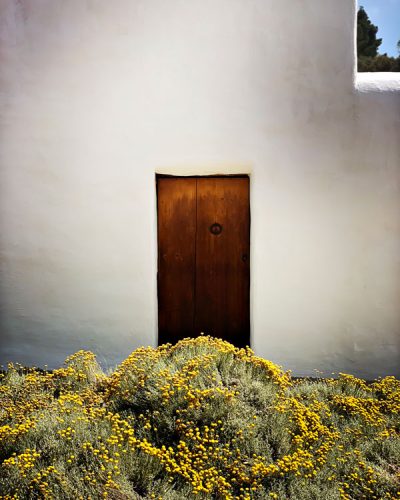
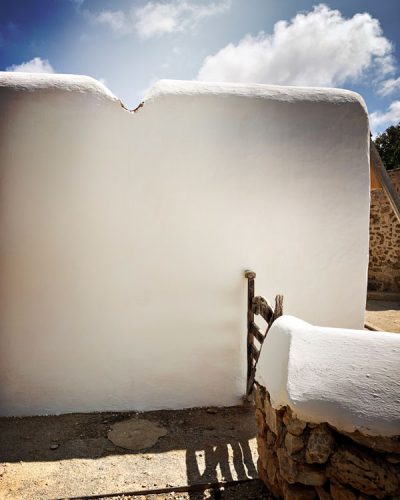
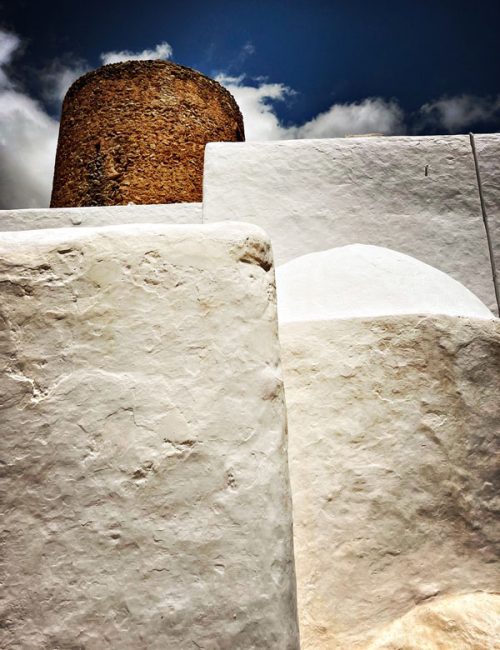
Blakstad offers us countless examples: walls, columns, the capitals of said columns, the design of the house floor plans, the decorative elements found within them, and even primitive measuring techniques such as the codada.
But there were two similarities that drew us closer to our passion for Egypt and perhaps provide a new insight into Ibizan constructions.
The first of these can be found in the facades of houses such as the Casa Frare Verd in Sant Agustí, which, as Blakstad shows us in his illustrations, are practically identical to the one we can see in the Temple of Luxor.
The second refers to the feixa portals, which Blakstad tells us directly that “are the same as those of Ancient Egypt.” These are portals used to cross the ditches in the marshy areas near the ports of Ibiza and Talamanca, which accurately reproduce not only the shape but also the dimensions of those of Ancient Egypt.
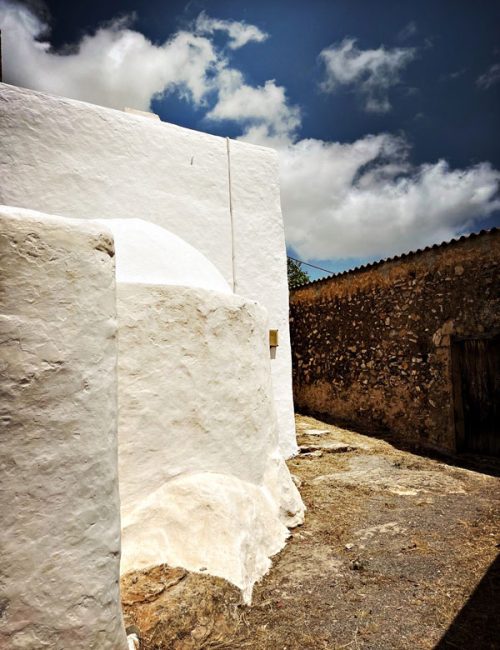
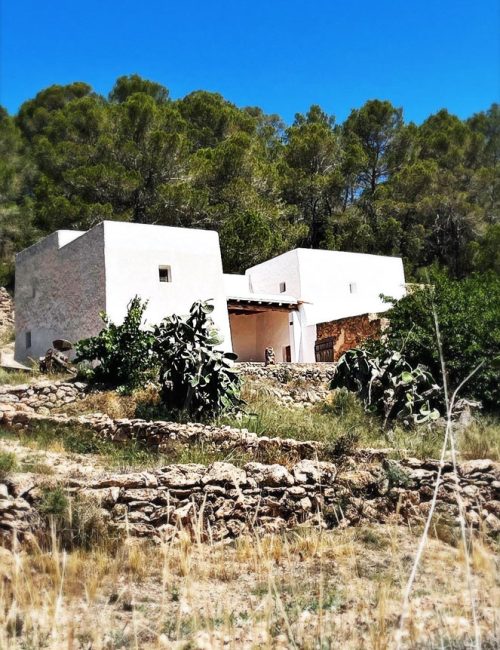
Schwaller de Lubicz made exhaustive measurements of the Luxor Temple, and his most surprising observations concern precisely the doors leading into the temple. These doors, which were later reproduced by the first Ibicencans, as Blakstad shows us, are an example of the anthropocosmic geometry that governed the buildings of Ancient Egypt, in which man reproduces on Earth the order that governs the Universe.
If we take the width of the door opening as a unit, their height is equal to Pi, the irrational number par excellence, whose numbers know no limit and invite us to infinity. Furthermore, Lubicz reveals, the hieroglyphic symbol representing “door” is read as sba, which also means “star” or “teaching”—the doors to the teaching of the stars.
It is absolutely fascinating that this old, sun-tanned peasant, shod in his espadrilles, dressed simply in his handmade gray cotton shirts and trousers, was able to capture with his hands, almost instinctively, a knowledge whose origin and symbolism he had unknown, but which he had inherited from the time of Ancient Egypt, reproduced accurately generation after generation until it has almost reached our days.
It was, without a doubt, a perfect, efficient system, in which each element had a specific function, a reason for being, a personality within the house, and where a harmonious symbiosis existed between them that formed a whole adapted to the island’s climatic conditions and the essence of humanity.
Or, in Blakstad’s own words, “the architecture of Ibiza was only one part of an organic, living relationship between man and nature.”
It may have been chance, that luck often guided by intuition, that has given us the opportunity to discover ancient Egypt in Ibiza. Although it’s even more likely that it was just a matter of time, that time that passes so unevenly on this island, and that sometimes stops to show us, face to face, the true magic of Ibiza.